

TME 83: What Does Cells in Your Body Do? There Are 37 Trillion Citizens Living Inside You. They Have Jobs, Weapons, and a Government.

And they've been running this nation — without a single day off — since before you were born.
Close your eyes for a second.
Imagine a country.
Not one you've visited — one that exists entirely inside your body, with borders made of vessels, roads made of arteries, and a population that never sleeps.
That country is your blood.
And like every functioning nation, it has citizens with jobs, an army with ranks, a supply chain, emergency responders, a construction crew — and one place where all of them are born.
You carry it everywhere. You've never thought of it this way. Let's change that.

The Capital City: Bone Marrow and the Stem Cell
Every nation needs a place where its citizens come from. A city of origin. A birthplace.
In the Nation of Blood, that city is called the Bone Marrow.
Right now, deep inside your bones — your spine, your ribs, the flat bones of your pelvis — there is a factory running at full tilt. It produces two to three million red blood cells every single second. Not per day. Per second.
Click here to read more about Bone Marrow.
At the heart of this factory lives a very special resident: the Stem Cell. Think of the stem cell as the parent of every other citizen in this nation. It doesn't have a fixed identity yet. It can become anything the nation needs — a soldier, a transporter, a repair crew member. When the nation is short on fighters, the stem cell makes fighters. When the transporters are running low, it makes more transporters.
There are roughly 10,000 to 20,000 stem cells per millilitre of bone marrow. A small number, but they are the most powerful citizens this nation has. Everything else descends from them.
The stem cell is the government's most valuable asset. Which is why, when the bone marrow fails — as it does in diseases like leukaemia — the entire nation collapses.
A nation is only as strong as its ability to produce citizens. Destroy the capital, and you destroy everything that follows.
The Workers: Red Blood Cells
Picture the red blood cell as the delivery worker of this nation. Every moment of every day, they load up at the lungs, pick up oxygen, and deliver it to every corner of the body — your brain, your muscles, your heart. Nobody gets oxygen without them.
Normal count: 4.5 to 5.5 million per microlitre of blood in men, and 4.0 to 5.0 million per microlitre in women. At any given moment, you have roughly 20 to 30 trillion red blood cells in your body. That is the largest workforce in the nation by a massive margin.
Here is the thing about red blood cells that most people don't know: they have no nucleus. No brain of their own. They are hollow containers shaped like tiny squished discs — designed purely for carrying haemoglobin, the molecule that grabs oxygen like a fist and releases it on demand.
Normal haemoglobin: 13.5 to 17.5 g/dL in men, 12.0 to 15.5 g/dL in women.
They also carry carbon dioxide back on the return trip. Load, deliver, collect, return. Over and over. For 120 days. Then they die and are replaced by fresh ones from the bone marrow.
When you are anaemic, it simply means the nation doesn't have enough delivery workers. The oxygen isn't reaching its destinations. You feel tired, breathless, and pale. The nation is understaffed.
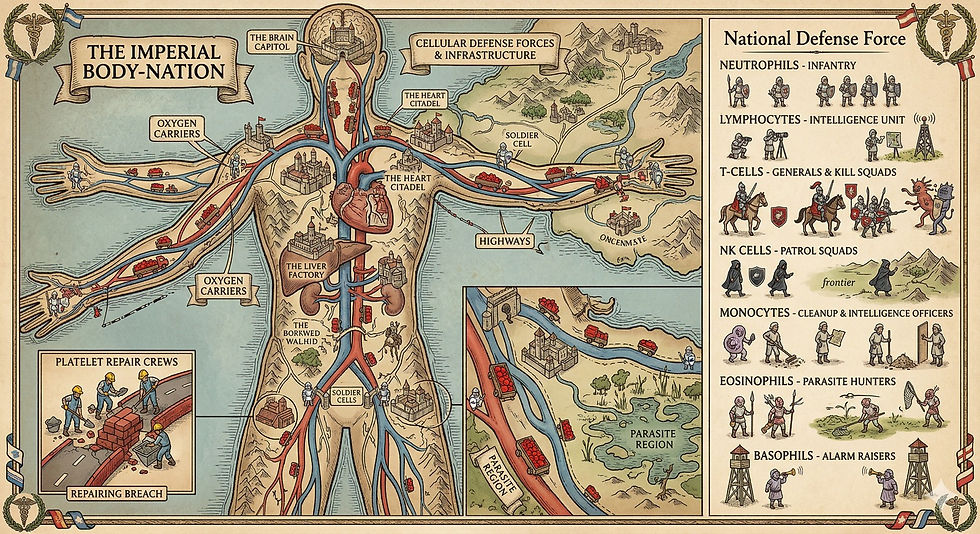
The Army: White Blood Cells
If red blood cells are the working class of this nation, white blood cells are the armed forces.
Normal count: 4,000 to 11,000 per microlitre of blood.
That might sound small compared to red blood cells — and it is. White blood cells make up less than 1% of your blood volume. But what they lack in numbers, they make up for in complexity. Because unlike the red blood cell, which has one job, the white blood cell is not even one type of cell. It is an entire military with multiple divisions, each with a different rank, weapon, and strategy.
Here are the five main divisions.
Division 1: Neutrophils — The Infantry
Normal count: 1,800 to 7,700 per microlitre. They make up 50 to 70% of all white blood cells.
Neutrophils are the foot soldiers. The first responders. When bacteria invade — say, when you step on something dirty and get a wound — neutrophils arrive within hours. They surround the bacteria, engulf it, and destroy it using a cocktail of toxic enzymes.
They don't care about the long game. They show up, they fight, they die on the battlefield. That white pus you see in an infected wound? That is mostly dead neutrophils. They gave their lives so you could heal.
Division 2: Lymphocytes — The Intelligence Unit
Normal count: 1,000 to 4,800 per microlitre. They make up 20 to 40% of all white blood cells.
This is where it gets sophisticated. Lymphocytes are the brains of the military. And they come in three important types.
B Lymphocytes are the weapons manufacturers. When they encounter an enemy — a virus, a bacteria — they study it. They identify its unique fingerprint. Then they manufacture a weapon so precise it can only destroy that exact enemy. That weapon is called an antibody. Think of antibodies as custom-made missiles. A B cell that has seen the flu virus will manufacture a missile shaped exactly like the flu virus's surface. When that virus returns, the missile locks on and neutralises it before it can cause harm.
This is why you don't get chickenpox twice. Your B cells made the weapon the first time. The weapon is still there, waiting.
T Lymphocytes are the kill squads and strategists. Some T cells — called cytotoxic T cells — identify infected cells and destroy them from the inside out. Others — called helper T cells — coordinate the entire immune response, deciding when to escalate, when to stand down, and which weapons to deploy. They are the generals.
Natural Killer Cells are the special operations unit. They don't wait for instructions or introductions. They patrol constantly, looking for two things: cells that look wrong, and cells that have been hijacked by viruses or turned cancerous. When they find one, they kill it. Fast. No paperwork required. Yes, that is their actual name.
Division 3: Monocytes — The Intelligence and Cleanup Crew
Normal count: 200 to 950 per microlitre. They make up 2 to 8% of all white blood cells.
Monocytes travel through the blood and, when they migrate into tissue, transform into cells called macrophages — large, powerful cells that eat debris, dead cells, and leftover pathogens after a battle. They are the sanitation department after a war.
But they are also intelligence officers. Macrophages present pieces of the defeated enemy to T and B cells, helping the military understand who attacked and prepare a more precise response next time. They are the ones who write the after-action report.
Division 4: Eosinophils — The Parasite Hunters
Normal count: 100 to 500 per microlitre. They make up 1 to 4% of all white blood cells.
Eosinophils are a specialised unit trained for a specific kind of threat — parasites and allergic reactions. Bacteria and viruses are small enough to be engulfed and destroyed. Parasites are not. They are too large to swallow. So eosinophils surround them and release toxic chemicals directly onto their surface, killing them from the outside in.
They are also heavily involved in allergic responses, which is why eosinophil counts are often elevated in people with asthma or allergies. The unit is doing its job — it is just misfiring at the wrong target.
Division 5: Basophils — The Alarm Raisers
Normal count: 20 to 100 per microlitre. They make up less than 1% of all white blood cells.
Basophils are the rarest soldiers in the army. Small in number, but critical in function. When the body encounters a serious threat — or in allergic reactions — basophils release a chemical called histamine, which triggers inflammation and alerts the rest of the immune system. They are the ones who set off the alarm.
When the alarm fires too easily — as in severe allergies — you get anaphylaxis. The nation goes into emergency mode over a perceived threat that isn't actually dangerous.

The Emergency Repair Crew: Platelets
Normal count: 150,000 to 400,000 per microlitre of blood.
Picture this: a water pipe in your city bursts. Water is gushing out. You have seconds before the damage becomes catastrophic.
Platelets are the emergency crew that arrives first. They are not even full cells — they are fragments of a larger cell called a megakaryocyte, broken off and released into the blood specifically to do this one job. The moment they detect a broken vessel wall, they activate, change shape, become sticky, and pile onto each other, forming a temporary plug.
But a plug alone isn't enough. That is where the clotting factors come in.
Clotting factors are proteins dissolved in your plasma — invisible, waiting. There are 13 of them, numbered Factor I through Factor XIII. When platelets signal an emergency, the clotting factors activate in a precise cascade, one triggering the next, each one converting the next into its active form. At the end of this cascade, a protein called fibrin forms long threads that weave over the platelet plug like scaffolding, creating a stable, hard clot that holds until the vessel is fully repaired.
In people with haemophilia, one of these 13 clotting factors is missing or deficient. The platelet plug forms — the emergency crew shows up — but without the scaffolding, it doesn't hold. A small cut becomes a prolonged bleed. It is not that their blood doesn't clot at all. It is that the construction crew is missing one critical tool, and the structure keeps falling apart.
The Highway: Plasma
Plasma is not a cell. It is the road every citizen travels on.
Normal volume: Plasma makes up about 55% of your total blood volume. In an average adult, that is roughly 2.7 to 3 litres of plasma circulating at any given time.
It is mostly water — about 92% — but what it carries is the nation's entire logistics system. Glucose for energy. Hormones carrying messages from one organ to another. All 13 clotting factors. Antibodies manufactured by B cells. Proteins that regulate pressure in blood vessels. Minerals, vitamins, waste products being transported to the kidneys and liver for disposal.
Without plasma, all the citizens — red cells, white cells, platelets — have no medium to travel through, no road to walk on. The nation stops functioning completely.
In medicine, plasma is extracted from donated blood and given to patients with burns, liver disease, or clotting disorders. You donate blood, and even if your red cells go to one patient and your platelets go to another, your plasma goes to a third person who needs it just as urgently.
One donation. Three citizens saved. Three different people in three different crises.
The Nation at Work: A Day in the Life
Right now, while you read this, here is what is happening inside you.
Your bone marrow is producing two to three million new red blood cells every second. Neutrophils are patrolling your bloodstream for bacteria. B cells are checking their antibody reserves. Platelets are circulating on standby, waiting for a vessel to breach. Plasma is carrying nutrients, hormones, and clotting factors across the entire network simultaneously.
There is no moment of rest. There is no night shift and day shift. The nation runs continuously, at scale, inside a body that is walking and eating and sleeping and is entirely unaware of what is keeping it alive.
When the Nation Falls Ill
Understanding these citizens changes how you understand disease.
Anaemia is not just "low haemoglobin." It is a shortage of delivery workers. Oxygen isn't reaching its destinations. The body compensates by making the heart beat faster, trying to deliver the same amount with fewer workers — which is why anaemic patients feel their heart racing.
A bacterial infection is not just "fever." It is a war. Your neutrophils are dying by the millions. Your temperature rises because the nation is deliberately heating itself to slow the invader down. The fatigue you feel is not weakness — it is the body diverting all its energy to the battlefield.
Leukaemia is a mutiny. One white blood cell starts reproducing uncontrollably, flooding the blood with useless copies of itself. It crowds out the delivery workers, overwhelms the real soldiers, and collapses the nation's infrastructure from the inside.
A blood transfusion is not just "receiving blood." It is immigration — citizens from another nation entering your bloodstream to fill roles your nation is critically short on. Which is why blood type matching matters: the receiving nation must recognise the incoming citizens as compatible. If it doesn't, it treats them as invaders. The army attacks. The situation worsens.

Why This Matters Beyond Biology
You might be thinking: this is a nice story, but what does it change?
It changes how you think about the bag of blood hanging in a hospital room. That is not a bag of fluid. That is a nation of cells — someone else's cells — entering a stranger's body to save their life.
It changes how you think about a blood donor. That person is not just donating a litre of liquid. They are sending workers, soldiers, and emergency responders to a nation in crisis.
It changes how you see your own body. Not as a machine you manage from the outside, but as a living ecosystem you are responsible for. Every cigarette you smoke damages the vessels the citizens travel through. Every night without sleep suppresses the immune army. Every dehydrated afternoon thickens the plasma the citizens need to move freely.
You are the land this nation lives on.
Take care of your land.
The Nation Never Asked to Be Acknowledged
It just kept working. Every second of your life, from the first heartbeat to the last — the citizens showed up, did their jobs, and kept you alive.
The least we can do is know their names.


Comments